

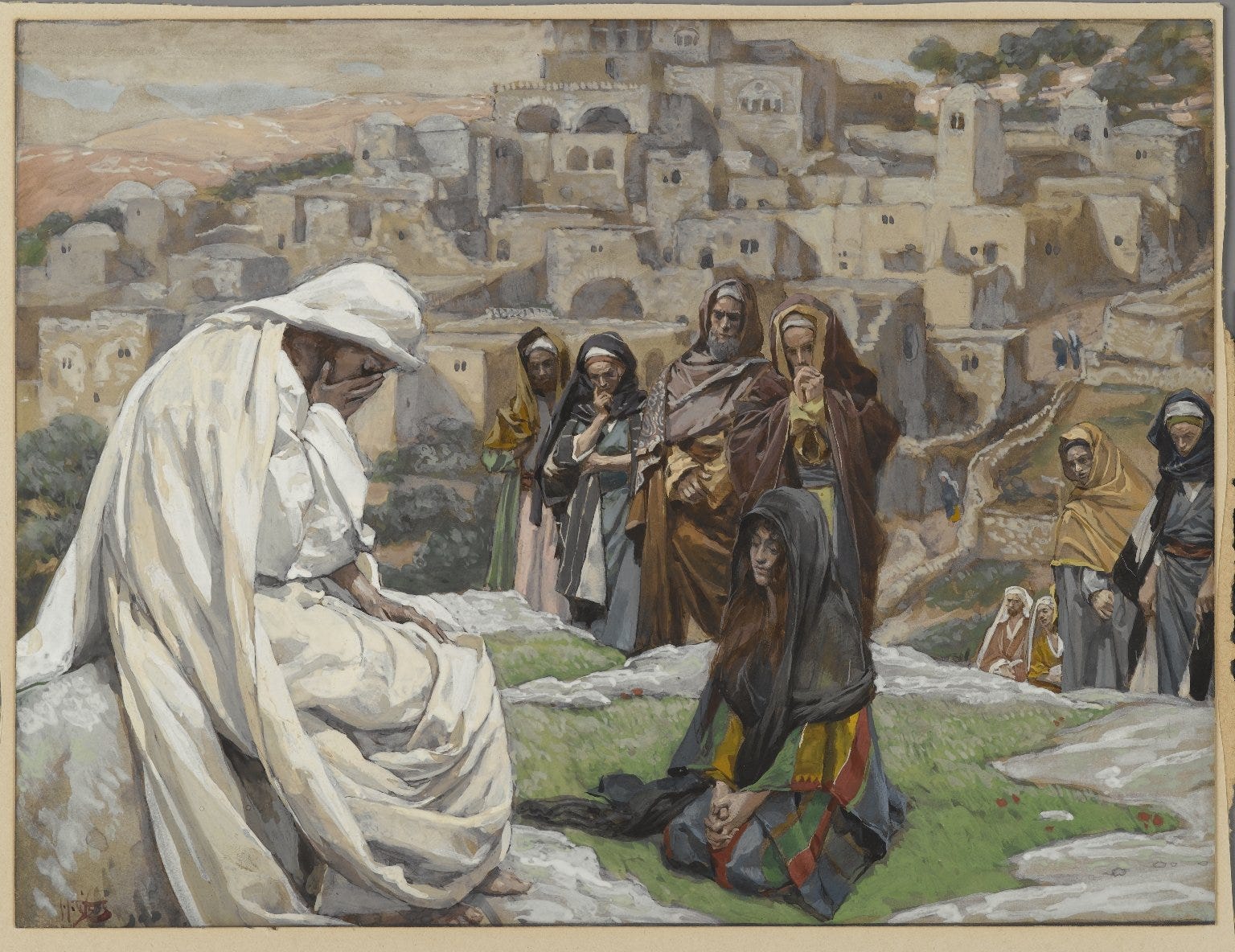
John 11:28 And when [Martha] had said these things, she went and called her sister Mary quietly, saying, “The Teacher is here, and he is calling you.” 29 When she heard this, she rose up quickly and went to him. 30 For Jesus had not yet arrived in the town. But he was still at that place where Martha had met him. 31 Therefore, the Jews who were with her in the house and who were consoling her, when they had seen that Mary rose up quickly and went out, they followed her, saying, “She is going to the tomb, so that she may weep there.” 32 Therefore, when Mary had arrived to where Jesus was, seeing him, she fell down at his feet, and she said to him. “Lord, if you had been here, my brother would not have died.” 33 And then, when Jesus saw her weeping, and the Jews who had arrived with her weeping, he groaned in spirit and became troubled. 34 And he said, “Where have you laid him?” They said to him, “Lord, come and see.” 35 And Jesus wept. 36 Therefore, the Jews said, “See how much he loved him!” 37 But some of them said, “Would not he who opened the eyes of one born blind have been able to cause this man not to die?”
There is something profoundly human, and profoundly divine, in this scene from John 11. After speaking with Jesus, Martha returns home and quietly calls her sister Mary: “The Teacher is here and is calling for you.” She says this in private, almost in a whisper. There are others around, mourners, skeptics, perhaps even those hostile to Jesus, and yet this call is not meant for the crowd. It is personal. The invitation to encounter Christ often comes this way: not loudly, not forcefully, but quietly, as something meant just for you.
Martha, having just been consoled by Jesus, does not keep that consolation to herself. She goes to her sister. There is something instructive in that alone: when we truly encounter Christ, we naturally want others to meet Him too. Grace is not something we hoard.
Mary’s response is immediate. As soon as she hears, she rises quickly and goes to Him. She does not linger in her grief, though her grief is real. She does not delay because others are present. There is an urgency here that speaks across time: when Christ calls, the right response is not hesitation, but movement. We often tell ourselves we will turn to God later when life is calmer, when we are more ready, but the Gospel quietly presses us: go now.
Jesus, meanwhile, has not yet entered the village. He remains where Martha met Him. This is not because He is distant, but because He does not force Himself into the situation. He waits. There is a kind of divine restraint here. Christ is present, but we are invited to go out and meet Him. Love does not coerce; it calls.
Those who are with Mary follow her, assuming she is going to the tomb to weep. They are acting out of compassion, not wanting to leave her alone in her sorrow. Yet, without realizing it, they are also being drawn into something much greater. What appears to be an ordinary act of mourning becomes the setting for a miracle that will need witnesses. God often works this way, drawing people into moments whose significance they do not yet understand.
When Mary reaches Jesus, she falls at His feet and says what Martha had said before her: “Lord, if you had been here, my brother would not have died.” The words are the same, but the posture is different. Mary does not engage in extended dialogue. She does not reason or question further. She falls. Her grief is expressed not in argument, but in surrender. There is both boldness and humility here: boldness, because she comes to Him openly despite the presence of others; humility, because she places herself at His feet. This is what faith often looks like, not the absence of sorrow, but sorrow brought honestly before God.
It is at this point that the Gospel turns inward, revealing the heart of Christ. When Jesus sees her weeping, and the others weeping with her, He is “deeply moved in spirit and troubled.” This is not a superficial emotion. It is something deeper, more complex. In Christ, we see both true humanity and true divinity. He feels sorrow, but not in a way that overwhelms or distorts Him. His emotions are perfectly ordered, fully human yet fully governed by truth.
What He experiences is not only sadness, but something like indignation, a kind of holy anger. He stands before death, not as something natural or neutral, but as an enemy. Death has entered the world through sin; it has wounded the human race, and here we see Christ confronting it. His sorrow is real, but it is not passive. It is the sorrow of one who sees clearly the devastation of sin and the cruelty of death, and who is about to act against it.
When He asks, “Where have you laid him?” it is not because He lacks knowledge. He already knows. The question is for those around Him. He draws them into the reality of the situation, invites them to acknowledge the finality of the tomb, so that what is about to happen cannot be dismissed or explained away. God often asks questions not to learn, but to lead us deeper into truth.
And then comes the moment that has echoed through centuries: “Jesus wept.”
These tears are not a sign of weakness, nor of despair. They are the expression of compassion. Christ does not stand at a distance from human suffering. He enters into it. He allows Himself to feel it. In doing so, He teaches us something essential: it is not wrong to grieve. The Stoics claimed that wisdom means the absence of sorrow, that the strong person remains untouched by loss. But Christ weeps. He affirms that grief, when rightly ordered, is part of our humanity.
At the same time, His grief is not without purpose or measure. He weeps, but He will also raise Lazarus. He feels sorrow, but not as one without hope. In this, He teaches us how to grieve: not by suppressing sorrow, nor by being consumed by it, but by holding it within the horizon of faith.
The crowd, witnessing this, is divided. Some say, “See how he loved him.” They recognize love in His tears. Others respond with doubt: “Could not he who opened the eyes of the blind man have kept this man from dying?” The same moment, the same Christ, reveals different things depending on the heart that sees Him. One sees love; another sees failure.
This passage draws us into a deeply personal question. How do we respond to Christ in our own moments of grief and confusion? Do we delay when He calls, or do we go to Him? Do we bring our sorrow honestly before Him, or do we hold back? And when we see Him at work, even in ways we do not fully understand, do we recognize His love, or do we question His power?
What stands at the center of it all is this: God is not unmoved by our suffering. He does not remain distant from it. In Christ, He enters into our grief, stands before the reality of death, and allows Himself to weep. And yet, His tears are not the end of the story. They are the prelude to resurrection.
Before He conquers death, He chooses to stand with us in it.
Inspired by St. Thomas Aquinas, Commentary on the Gospel of John.