

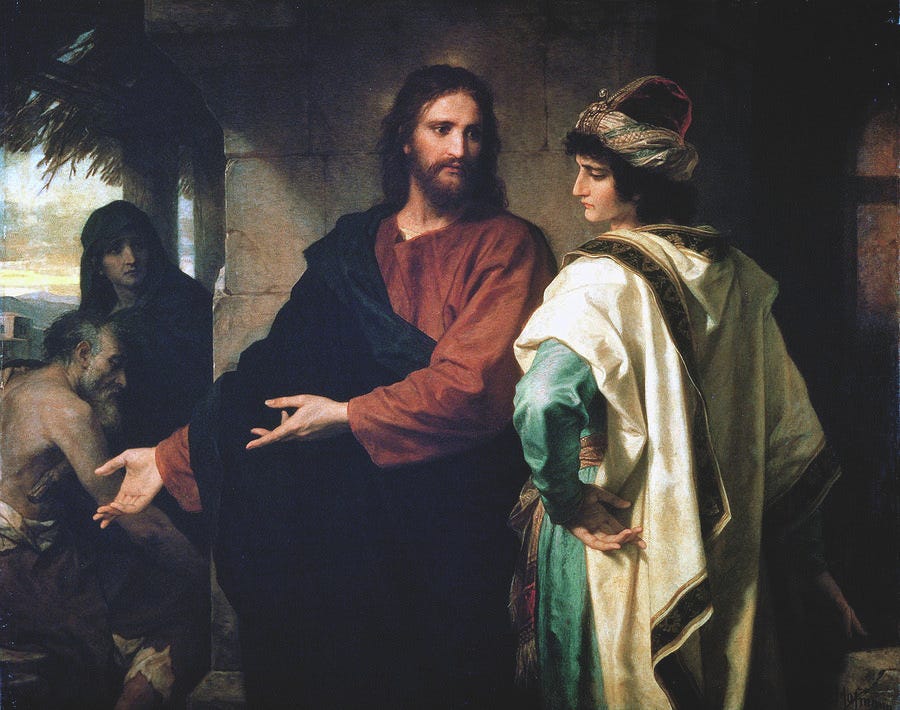
Christ’s encounter with the rich young man is not primarily a warning about having possessions. It is a warning about becoming one.
There is a peculiar kind of sadness that comes not from failing to find what we want, but from finding it and discovering that we do not want it quite enough.
This is the sadness of the rich young man.
He approaches Jesus with a question any sensible person ought eventually to ask:
“What good should I do, so that I may have eternal life?”
It is an excellent question. Indeed, it is far better than most of the questions with which we ordinarily occupy ourselves: How can I earn more? How can I be admired? How can I remain comfortable? How can I avoid becoming bored?
The young man has looked beyond all these smaller concerns and asked about eternal life. Yet even a good question may conceal a mistaken assumption. He seems to imagine eternal life as one more possession to acquire. He has wealth, status, youth, and moral respectability. Perhaps eternal life is the final item needed to complete the collection.
He asks what he must do so that he may have it.
But eternal life is not an ornament that can be added to an otherwise self-governed existence. It is life with God. And life with God cannot be possessed in the same way that one possesses a house, a field, or a purse of coins.
One does not put God in one’s pocket.
Rather, one discovers, sometimes with considerable alarm, that God intends to put us in His Kingdom.
Jesus directs the young man’s attention to God, who alone is good in the fullest sense.
This is not to say that creatures are evil. A loaf of bread is good. Friendship is good. A warm house in winter is good. So are music, marriage, health, laughter, learning, and honest work. Christianity has no quarrel with created goodness. The quarrel begins when we demand that a created good do the work of the Creator.
All earthly goods are borrowed lights. God is the sun.
The trouble begins when a man becomes so enamored of a beam shining upon the floor that he refuses to look through the window.
The young man is searching for the good, and the Good Himself is standing before him. Yet he has not recognized what this encounter will require. To ask God for eternal life is to ask Him to rearrange every other love in our lives.
We tend to prefer a God who will bless our existing arrangement.
Christ offers to replace it.
Jesus first tells the young man to observe the commandments. He mentions those concerning murder, adultery, theft, false witness, honoring parents, and loving one’s neighbor.
This is important because people sometimes speak as though love and commandments were enemies. They imagine love to be warm, generous, and spontaneous, while commandments are thought cold and restrictive.
But genuine love always has a shape.
If I love my neighbor, I will not murder him, deceive him, rob him, or seduce his wife. A man who claims to love humanity while mistreating every actual human being he meets does not possess an unusually spiritual love. He possesses an unusually convenient imagination.
The commandments bring love down from the clouds and place it in the kitchen, the marketplace, the bedroom, the courtroom, and the family home. They tell us that holiness concerns what we do with bodies, promises, money, words, and other people.
They are not arbitrary obstacles placed between us and happiness. They are more like the banks of a river. Without them, the water does not become gloriously free; it becomes a swamp.
The moral life finds its fulfillment in the commandments, but these commandments must be understood in relation to Christ, the source and goal of Christian life.
The young man replies that he has observed these things. We need not suppose that he is lying.
In St. Mark’s account, Jesus looks upon him with love before giving him the harder invitation (Mark 10:21). This is not the treatment of a charlatan being publicly exposed. It is the treatment of a sincere man being invited further.
The young man has obeyed. He has behaved respectably. Yet something within him remains restless.
“What is still lacking for me?” he asks.
That question is dangerous because Christ may answer it.
Many of us are willing to ask God whether we have done anything terribly wrong. We are less eager to ask whether we have withheld anything from Him. The first question permits us to compare ourselves favorably with criminals. The second places us beside the saints.
There is an enormous distance between saying, “I have avoided the worst sins,” and saying, “My whole life belongs to God.”
The young man has reached the frontier between moral respectability and sanctity. He has not committed the sins named by Christ. But freedom from grave wrongdoing is not yet the same as perfect freedom for love.
A cage made of gold remains a cage. Indeed, it may be harder to escape because one has become proud of its furnishings.
Jesus tells him to sell what he has, give to the poor, and follow Him.
It would be easy to misunderstand this. Christianity does not teach that matter is evil or that lawful ownership is sinful. A man may own a great deal without being greedy, just as another may own almost nothing while thinking about money every waking hour.
The quantity of wealth is not the only question. The more searching question is: What authority does it exercise over the heart?
The young man thought he possessed many things. Christ’s command reveals that the things possessed him.
We often speak of “having” a habit, an ambition, a reputation, or a fortune. Yet the language may conceal the reality. The habit may have us. The ambition may direct us. The reputation may frighten us into silence. The fortune may dictate what sacrifices we consider impossible.
Possessions make useful servants but dreadful masters. They begin by offering us comfort and end by demanding our obedience.
The young man’s riches are not merely sitting in his house. They have taken up residence in his will.
Not every Christian receives the identical practical command given to this man. The Church recognizes evangelical poverty as a particular calling, especially within consecrated life. But no Christian is excused from the deeper demand hidden within it.
Everyone must become detached enough to obey God.
For one person, the obstacle may be money. For another, it may be reputation. For another, pleasure, professional success, romantic attention, political influence, resentment, control, or even a carefully maintained image of being a good person.
The most dangerous idol is not always the thing we openly worship. It is often the thing we have quietly decided God may never ask us to surrender.
We might imagine Christ entering the house of the soul. We welcome Him warmly into the sitting room. We show Him the religious pictures. We offer Him the finest chair. But when He approaches a certain locked door, we become uneasy.
“Anywhere but there, Lord.”
Unfortunately (or rather, mercifully) that room is often the very reason He has come.
Christ does not ask the young man to embrace mere emptiness. He promises him treasure in heaven.
This is the part we regularly forget. Renunciation appears irrational only when we ignore what is being offered in exchange.
A child may think his father cruel for taking a dangerous object from his hand. He notices what is being removed but does not understand what is being protected. We often look at divine commands in precisely this childish way. We see the surrender; God sees the freedom. We count what leaves our hands; He considers what He wishes to place within them.
Earthly goods are real goods, but they are temporary and limited. They cannot bear the full weight of the human desire for happiness. To demand that they do so is unfair both to ourselves and to them.
We spoil created things by asking them to be God.
Money can purchase medicine, but not immortality. It can purchase entertainment, but not joy. It can surround a man with flatterers, but it cannot guarantee one faithful friend. It can provide a luxurious bed, but not a peaceful conscience.
Christ does not oppose lesser goods because they are good. He opposes their enthronement because they are lesser.
The heart of the passage is not “sell.” Nor is it merely “give.”
It is:
“Come, follow me.”
The Christian faith is not ultimately an exercise in subtraction. Its goal is not to see how miserable, empty, or uncomfortable a person can become. The young man is asked to leave something because Someone is calling him.
Poverty, when embraced for Christ, is not simply the absence of money. It is the creation of room. Obedience is not the destruction of freedom but its direction toward the good. Sacrifice is not holy merely because it hurts; it becomes holy when love offers it to God.
Christian perfection consists in charity. All Christians, whatever their vocation or state of life, are called to the fullness of Christian life and the perfection of love. The outward form of surrender differs from person to person, but the inward destination is the same: the whole heart must belong to Christ.
There are many vocations, but there is no Christian vocation to mediocrity.
The young man goes away sad because he has many possessions.
His sadness is remarkably instructive. He does not laugh at Christ’s invitation. He does not dismiss it as foolish. Nor does he become openly hostile. He seems to recognize something true and beautiful in the call.
But he cannot accept its price.
This is not the sadness of a man who has learned that eternal life is unavailable. It is the sadness of a man who has discovered that he cannot carry all his idols into it.
He wanted eternal life, but he wanted it as an addition to his present loyalties. Christ offered it as the transformation of those loyalties. The young man desired heaven provided that heaven did not begin interfering too seriously with earth.
But heaven is not merely an endless continuation of our present preferences. It is the perfect enjoyment of God. If we do not wish God to govern us now, it is difficult to understand what we mean when we say we wish to live with Him forever.
The man’s sorrow reveals a divided heart: one part drawn toward Christ, the other chained to wealth.
And a divided heart is miserable precisely because it has seen enough of the greater good to become dissatisfied with the lesser, but not loved the greater good enough to release the lesser.
The Gospel does not tell us whether the young man eventually returned.
Perhaps, years later, he remembered the face of Christ and understood that the command had been spoken in love. Perhaps he gave away his fortune. Perhaps he became a disciple after all.
Or perhaps he spent the rest of his life adding to the possessions that had already cost him the one thing he truly wanted.
The silence is fitting, because the conclusion of the story does not belong only to him. It belongs to each reader.
Christ may not be asking you to sell everything. But He is certainly asking whether everything is His.
What would make you walk away sorrowful?
What loss seems worse than disobedience?
Which door of your life remains locked when Christ approaches?
The final irony is that we cling to lesser things because we fear becoming poor, while that very clinging impoverishes us. The rich young man departs with all his property intact. Yet the Gospel presents him not as the man who kept everything, but as the man who walked away from his greatest treasure.
He came asking how to have eternal life. He discovered that eternal life begins when we stop treating God as one more thing to possess and allow ourselves to be possessed by Him.
Christ does not ask for the whole heart because He wishes to diminish it.
He asks for the whole heart because only He can make it whole.