

This is the third installment in a series exploring St. Paul’s Letter to the Romans with the help of St. Thomas Aquinas.
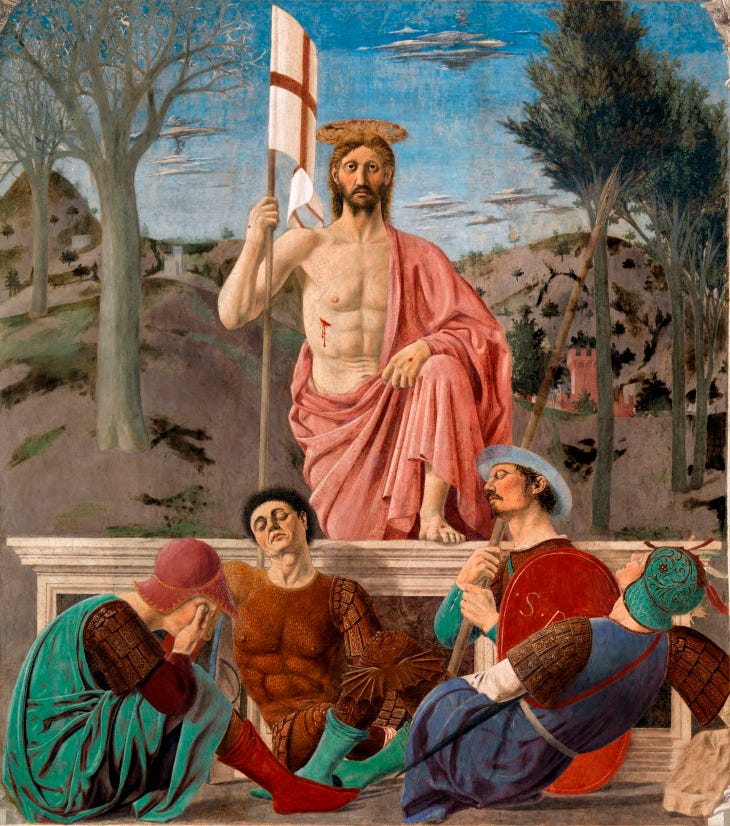
Having spoken of Christ’s eternal origin as the Son of God and his temporal descent from David according to the flesh, St. Paul now directs our attention to Christ’s divine power:
“Who was predestined the Son of God in power, according to the spirit of sanctification, by the resurrection of our Lord Jesus Christ from the dead.” — Romans 1:4, Douay-Rheims
This is a difficult verse. Read carelessly, it might seem to imply that Jesus was once merely human and later became the Son of God—perhaps at his Resurrection. But that cannot be Paul’s meaning. He has already identified Christ as God’s own Son who entered David’s line according to the flesh.
The eternal Son did not become divine. Nor was he promoted to divine sonship as a reward for his earthly life. Rather, the one who eternally possesses the divine nature assumed a human nature. His divine identity and power were manifested in history through the Holy Spirit and the Resurrection.
St. Thomas Aquinas finds three central themes in this verse:
Christ’s predestination
His dignity as the Son of God in power
The signs of his divine power: the sanctifying Spirit and the Resurrection
Together, these reveal not only who Christ is, but also what God desires to accomplish in us through him.
---
1. What does “predestined” mean?
The word predestination can easily lead to confusion. Aquinas begins by explaining its basic meaning.
To predestine is to determine or order something beforehand toward an end. Predestination belongs to God’s eternal plan for realities that surpass the natural powers of creatures.
Certain things belong to us by nature. Human beings naturally possess bodies, intellects, wills, and the capacities that follow from human nature. We would not ordinarily say that someone was predestined to have hands or to possess a rational soul.
Predestination concerns a supernatural end: something to which human nature could never attain by its own power.
The supreme supernatural end is communion with God. A rational creature can be united to God in several ways:
through special gifts given for the benefit of others, such as prophecy;
through sanctifying grace, by which a person becomes an adopted child of God;
and, uniquely in Christ, through the personal union of human nature with the eternal Son.
This final reality is the grace of the Incarnation, often called the grace of union. The humanity of Christ is united not merely to divine assistance or influence, but personally to God the Son.
Christ’s human nature does not belong to a separate human person. It belongs to the eternal Person of the Word.
---
2. Christ did not become the Son of God
We must immediately guard against a serious misunderstanding.
When Paul speaks of Christ as predestined or designated Son of God, he does not mean that Jesus was first an ordinary man and later became divine. The Person of Jesus Christ is the eternal Son, who always was and always will be God.
Aquinas rejects any interpretation that would divide Christ into two persons: one eternal and divine, the other temporal and human. The Son of God and the Son of Man are one and the same Person. The one born of Mary is the one eternally begotten of the Father.
For this reason, we cannot properly say that a human person began to be the Son of God. There is no created human person in Christ who was elevated into divinity. There is one eternal divine Person who assumed a complete human nature.
As Aquinas explains, the phrase “Son of man” already refers to the eternal Person who was always the Son of God. Therefore, Christ was never a merely human subject who afterward acquired divine sonship [Commentary on Romans (St. Thomas Aquinas) §1:49].
The Incarnation is not a man’s ascent into divinity. It is the Son’s descent into humanity.
---
3. Predestined according to his humanity
How, then, can Paul say that Christ was predestined to be the Son of God?
Aquinas explains that statements about Christ can refer to him according to either of his two natures.
Because Christ is one Person in two natures, we may speak of him:
according to his divine nature, as when we confess his unity with the Father;
or according to his human nature, as when we say that he was born, suffered, died, and rose again.
The eternal Person of the Son was not predestined to become divine. He is eternally God. But according to the humanity he assumed, Christ was eternally ordained to exist in the most intimate possible union with God: the union of human nature with the Person of the eternal Son.
The predestination, therefore, concerns the mystery of the Incarnation. From all eternity, God willed that the human nature conceived in the Virgin Mary would belong personally to the Son.
This was not something Christ’s humanity earned by prior merit. Before that humanity existed, it could not perform any meritorious action. Its union with the Word was a completely gratuitous gift of God.
The humanity of Christ is thus the supreme example of grace.
---
4. The grace of union
Ordinary Christians are united to God through sanctifying grace. Christ’s humanity, however, is united to God in a unique manner: through personal union.
This does not mean that Christ’s humanity becomes the divine nature. The divine and human natures remain distinct. His humanity remains truly human, while his divinity remains fully divine.
Yet both natures belong to one Person—the eternal Son.
This is why we can say that:
God the Son was born of the Virgin Mary;
God the Son suffered according to his humanity;
God the Son died according to his humanity;
and the man Jesus Christ is truly the eternal Son of God.
The Person performing these actions is divine, even when the actions belong to his human nature.
Aquinas illustrates this through ordinary human experience. We can say that a man is wounded according to his body or that he understands according to his soul. The same person is the subject of both kinds of action, although the actions arise through different principles.
In an incomparably greater way, the one Person of Christ acts according to either his divine or his human nature.
---
5. “The Son of God in power”
Paul does not speak only of the Son of God, but of the Son of God in power.
This addition excludes any merely adoptive understanding of Christ’s sonship. Christians are truly children of God, but we are children by adoption and grace. Christ is the Son by nature.
His power is not simply that of a holy man favored by God. He possesses the very divine power of the Father. The Son does what the Father does because the Father and the Son possess the same divine nature.
Christ is therefore not merely one instrument among others through whom God acts. He is himself the divine Son, the power and wisdom of God.
The miracles of Jesus are signs of this identity. He forgives sins, commands the wind and sea, expels demons, gives life to the dead, and teaches with sovereign authority. Yet the supreme manifestation of his divine power is his victory over death.
Paul’s expression does not mean that Christ lacked divine power before the Resurrection. It means that his divine sonship and power were publicly manifested through the Resurrection.
What he possessed eternally was revealed in time.
---
6. Designated or revealed?
Aquinas considers another possible understanding of Paul’s language.
The word translated in the Latin tradition as predestined may be understood more broadly as designated, foreknown, or manifested. On this reading, Paul is saying that Christ was eternally foreknown and then revealed in history as the Son of God in power.
The Resurrection did not give Jesus a divinity he previously lacked. Instead, it manifested who he had always been.
Aquinas compares this with Christ’s words after the Resurrection concerning the authority given to him. Christ did not suddenly acquire divine authority that had been absent before. Rather, his universal authority was now manifested openly in his risen humanity [Commentary on Romans (St. Thomas Aquinas) §1:50–51].
The distinction is crucial:
Jesus did not become the eternal Son at his Resurrection.
Jesus was revealed in power as the eternal Son through his Resurrection.
The tomb did not transform a mere man into God. The empty tomb manifested the victory of the God-man.
---
7. Christ’s predestination and ours
Aquinas now draws a profound connection between Christ and the Christian life.
Christ’s natural sonship is the source, measure, and pattern of our adoptive sonship. He is the Son by nature; we become sons and daughters by participation in his grace.
Everything that exists by participation depends upon that which possesses the perfection in itself. A heated object participates in heat; it does not possess heat in the same way as the fire that warms it. Similarly, Christians participate by grace in the filial relationship that belongs naturally and eternally to Christ.
Our adoption is therefore not independent of him. We become children of God only by being conformed to the Son.
St. Paul later describes believers as predestined to be conformed to the image of God’s Son (Romans 8:29). Christ is not merely an example standing outside us. Through grace, the Holy Spirit unites us to him and shapes his likeness within us.
The predestination of Christ’s humanity to personal union with the Word is thus the pattern of our predestination to adopted sonship [Commentary on Romans (St. Thomas Aquinas) §1:48–49].
He is Son by nature. We are made children of God through him.
---
8. Grace comes before merit
This relationship between Christ’s sonship and ours also teaches us the priority of grace.
Christ’s humanity did not merit personal union with the eternal Son through some action performed before the Incarnation. The union itself came first as the utterly free gift of God.
In an analogous but lesser way, our adoption as God’s children does not begin with our merits. Grace precedes our good works, heals and elevates our powers, and enables us to act meritoriously in communion with God.
Aquinas explains that the man Christ was not ordained to divine sonship because of antecedent merits. Likewise, our adoption has its first cause in grace rather than in some prior worthiness of our own [Commentary on Romans (St. Thomas Aquinas) §1:48–49].
This does not make human freedom or good works irrelevant. God’s grace does not destroy our freedom; it heals and perfects it. Once moved and strengthened by grace, we can truly cooperate with God.
But grace always has the first word.
The Christian cannot stand before God and claim: “I made myself worthy of adoption.” Divine sonship is received before it is lived. Our good works are the fruit of grace, not the cause of God’s first mercy toward us.
---
9. The weakness of the flesh and the majesty of God
Paul’s movement from Christ’s descent according to the flesh to his manifestation as Son of God in power protects the fullness of the Incarnation.
The majesty of Christ’s divinity does not eliminate the weakness of his humanity. He truly experiences hunger, fatigue, sorrow, suffering, and death.
At the same time, the weakness assumed in his humanity does not diminish his divinity. Even in the humility of the manger and the agony of the Cross, he remains the eternal and almighty Son.
The mystery contains no competition between God and humanity. Christ does not need to be less human in order to be divine, nor less divine in order to be truly human.
In him, perfect divinity and complete humanity are united in one Person.
This has profound consequences for Christian spirituality. Our weakness does not necessarily mean that God has abandoned us. In Christ, divine glory is revealed precisely through freely accepted human weakness.
The Cross appears to be defeat, but becomes the throne of divine love. The tomb appears to be the end, but becomes the place from which life enters the world.
---
10. The Spirit of holiness
Paul says that Christ is manifested as Son of God in power according to the Spirit of holiness, or the Spirit of sanctification.
Aquinas connects this phrase with the Holy Spirit and Christ’s power to sanctify.
To sanctify is to make holy—to set someone apart from sin and unite that person to God. This work belongs properly to divine power. No creature can produce sanctifying grace as its principal cause, because grace is a supernatural participation in God’s own life.
Christ reveals his divinity by giving the Holy Spirit.
He promises to send the Spirit from the Father, and through the Spirit he cleanses, justifies, and sanctifies his people. Christians are sanctified in the name of the Lord Jesus Christ and in the Spirit of God.
Aquinas therefore interprets the phrase as pointing to Christ’s power to bestow the sanctifying Spirit. Christ is shown to possess divine power because he gives the Holy Spirit through whom human beings are made holy [Commentary on Romans (St. Thomas Aquinas) §1:58–59].
Jesus does not merely instruct us to become holy through our own efforts. He gives us the Spirit who makes holiness possible.
---
11. The Spirit and the Resurrection
Aquinas closely associates the outpouring of the Holy Spirit with Christ’s Resurrection and glorification.
This does not mean that the Holy Spirit was entirely absent before Easter. The patriarchs, prophets, and saints of the Old Covenant received grace through the anticipated merits of Christ. The Virgin Mary was full of grace before the Resurrection, and the apostles experienced the Spirit’s action during Christ’s earthly ministry.
Rather, after Christ rose and was glorified, the Spirit began to be given in a new, abundant, and universal manner [Commentary on Romans (St. Thomas Aquinas) §1:58–59].
What had been promised through the prophets now pours forth upon the Church. The grace once manifested particularly within Israel is proclaimed to all nations. The risen Christ sends his apostles into the world and bestows the Spirit for the forgiveness of sins and the sanctification of humanity.
Easter and Pentecost therefore belong together.
The risen Christ does not merely return to life for his own sake. He communicates his victorious life to us through the Holy Spirit.
---
12. The Resurrection as the sign of divine power
The Resurrection is the decisive sign of Christ’s divine power.
Christ’s rising differs fundamentally from ordinary restoration to earthly life. Those whom Jesus raised during his ministry—such as the daughter of Jairus and Lazarus—returned to mortal life and would eventually die again.
Christ rises to an immortal and glorified life. Death no longer has dominion over him.
His Resurrection confirms the truth of his teaching, vindicates his claims, reveals the saving value of the Cross, and inaugurates the new creation. It is the Father’s public vindication of the crucified Son and the manifestation of the Son’s own life-giving power.
The Father raises the dead, and the Son likewise gives life. Christ’s Resurrection reveals not only that God acted upon Jesus, but that the Son himself possesses divine authority over life and death.
The one who surrendered his life freely takes it up again in triumph.
---
13. Christ raises the dead
Aquinas considers several dimensions of Christ’s power to raise the dead.
First, Christ’s victory was accompanied by signs involving the righteous dead. The Gospel of Matthew recounts that after Christ’s death, the tombs were opened and the bodies of many saints arose (Matthew 27:52–53).
Second, Christ will raise all the dead at the end of history. The Resurrection of Jesus is not an isolated miracle. It is the beginning and cause of the general resurrection. The voice of the Son will call all who are in the tombs to come forth.
Third, Christ raises human beings spiritually from the death of sin. Mortal sin is a spiritual death because it deprives the soul of sanctifying grace, the principle of supernatural life. Through Christ, sinners are restored to friendship with God.
The Resurrection therefore has three horizons:
Christ has risen bodily from the dead.
He raises sinners spiritually through grace.
He will raise the dead bodily at the end of time.
Easter reaches into the past, transforms the present, and opens the future.
---
14. The spiritual resurrection from sin
The spiritual resurrection begins when Christ calls the sinner out of darkness and restores the life of grace.
Sin can become a kind of tomb. It encloses the human person within pride, disordered desire, resentment, fear, or despair. Someone may remain biologically alive while spiritually separated from God.
Christ does not merely stand outside this tomb and offer advice. He calls the dead to life.
This resurrection begins through conversion and is given sacramentally in Baptism. After Baptism, when grave sin has wounded or destroyed the life of grace, Christ restores the repentant through the Sacrament of Penance.
Every true conversion is therefore an application of Easter.
The same Lord who called Lazarus from the tomb speaks to the sinner: arise and come forth. The same Spirit who raised Jesus gives supernatural life to those dead in sin.
Christian morality is not an attempt by the spiritually dead to imitate the behavior of the living. It is the fruit of new life received from Christ.
---
15. Christ’s Resurrection and our hope
Because Christ has risen, Christian hope is not vague confidence that everything will somehow turn out well.
It rests upon an event: Jesus Christ has conquered death.
The Resurrection reveals that sin, suffering, injustice, and death do not possess the final word. Yet Christian hope does not deny these realities. The risen Lord still bears the wounds of the Crucifixion. Redemption does not pretend that suffering never occurred; it transforms suffering from within and carries it into glory.
Our final destiny is not the escape of the soul from the body forever. Christ will raise the body. Salvation embraces the whole human person.
The body that suffers, labors, worships, loves, and dies will be raised and transformed by divine power. Christ’s risen humanity is the firstfruits and pattern of what God intends for those united to him.
The Resurrection of Jesus is therefore both revelation and promise. It reveals who he is, and it promises what his grace will accomplish in us.
---
16. The full meaning of Christ’s power
Worldly power is often measured by the ability to command, dominate, or destroy. Christ reveals a different and infinitely greater power.
His is the power:
to unite human nature personally to God;
to forgive sins;
to sanctify human souls;
to give the Holy Spirit;
to draw life from death;
to raise sinners through grace;
and finally to raise the bodies of the dead.
Christ’s power is life-giving power.
It reaches its most striking manifestation not in avoiding death, but in passing through death and defeating it. His kingship is revealed through self-giving love, and his victory is revealed through the Cross and empty tomb.
The Son of God in power is the crucified and risen Lord.
---
The Son revealed in glory
Romans 1:4 does not teach that Jesus became the Son of God at Easter. It proclaims that the eternal Son, who truly assumed our humanity, was manifested in power through the Holy Spirit and the Resurrection.
His humanity was eternally predestined for personal union with the Word. This supreme grace was not earned by prior merit. It arose from God’s entirely free and loving purpose.
Christ’s natural sonship then becomes the source and pattern of our adopted sonship. We do not become children of God apart from him, but through conformity to him. Grace incorporates us into the Son so that, in the Holy Spirit, we may approach his Father as our Father.
The Resurrection reveals this mystery in power. The crucified Jesus is not merely a teacher whose followers preserved his ideals. He is the living Lord who gives the Holy Spirit, raises sinners from spiritual death, and will one day call the dead from their tombs.
The Gospel is not only the announcement that Christ lives.
It is the announcement that, because Christ lives, those who belong to him may live also.
---
Principal source
St. Thomas Aquinas, Commentary on the Letter of Saint Paul to the Romans, chapter 1, lecture 3, §§42–59.
Disclaimer
This article was written with the assistance of Catholic AI and is based principally on St. Thomas Aquinas’s Commentary on the Letter of Saint Paul to the Romans.